

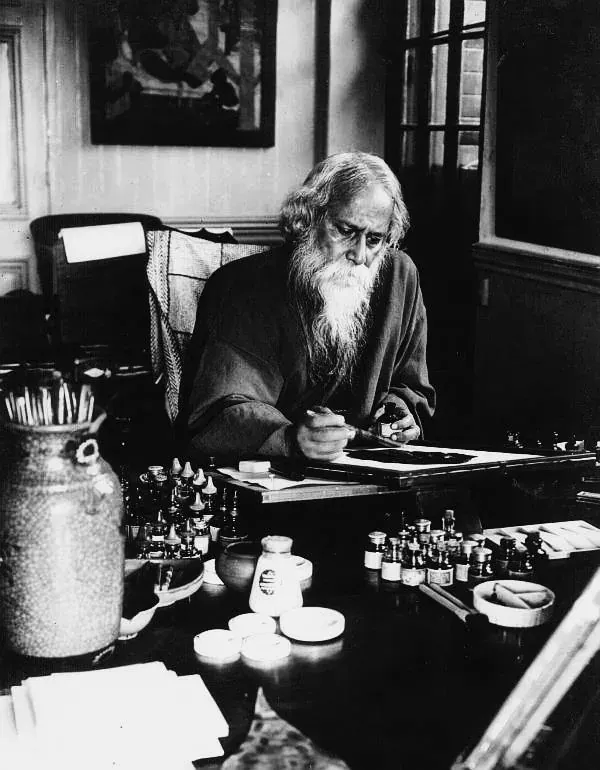

Ernest Hemingway described a strange writing ritual: stopping each morning in the middle of a sentence, when he knew what was coming next. He always, he wrote, "stopped when I knew what was going to happen next. That way I could be sure of going on the following day."1
The detail seems incidental. Yet it says something about what is really at stake in writing a long text: the difficulty is not so much producing as returning. A novel, an essay, any text that exceeds a single session is written across several returns — separated by nights, weekends, sometimes weeks. And between those returns, something crumbles: a mental state, a familiarity with the text, an availability to its world.
Stephen King says it in a sentence: "If I don't write every day, the characters begin to stale off in my mind — they begin to seem like characters instead of real people."2 Annie Dillard says it more forcefully still: "A work in progress quickly becomes feral. It reverts to a wild state overnight. … You must visit it every day and reassert your mastery over it."3
In the first article in this series, I argued that regularity was the real lever of writing. In the second, I showed the concrete forms it takes among writers who last: time, place, ritual, permission. There remains a question we have not really asked: what is it for? Why does this practice, more than most, demand a daily return — to the point that King and Dillard, who have nothing in common, both describe what happens in its absence as a form of degradation?
The Fictional Dream, and What Erodes It
The novelist John Gardner left a formula that helps identify what is at stake: the "vivid and continuous fictional dream."4 This is what the good novel produces in its reader: a state of immersion that, when it holds, makes one forget one is reading. But Gardner adds a point that is less often retained: the writer must themselves inhabit this dream before being able to make it hold. You cannot describe a scene you cannot see. You cannot make a room felt if you have not, yourself, returned to it that very morning.
This state is fragile. Haruki Murakami describes his daily routine — five to six hours of writing, every morning — as "a form of mesmerism."5 The repetition does not create the state; it sustains it. It maintains a mental availability that, left to itself, does not last.
This availability is precisely what erodes between sessions. Not the material: it is on the page, waiting. But the relationship to that material, the familiarity with the characters, the ability to hear their voices. King does not say his pages disappear. He says that his characters, in his mind, begin to look like characters — that they stop being alive and become constructions again. The erosion is not one of content. It is one of presence.
This presence can only be maintained by returning. The longer one waits, the further what one finds drifts from what one had left.
A Work Written Across Several Returns
Why, then, not write everything in one go? The question is almost naïve, but worth asking: if each interruption threatens the state, why accept interrupting?
Because one has no choice. Cal Newport recalls a convergent observation among researchers who have studied demanding cognitive work6: the human capacity to sustain deep concentration on a difficult task plateaus at around four hours per day. Beyond that, quality drops. The writers cited in previous articles — three hours for Mann, five to six for Murakami, two and a half for Trollope — are not falling short of an ideal. They are roughly at the biological ceiling for the kind of work they do.
A novel, a long essay, a book — by construction, none of these can be written in a single session. They are written across several returns, each limited to a few hours. Writing is therefore the craft in which fragmentation is not a failure. It is the condition.
But each fragment must reconnect with the preceding mental state. Hence a specific problem: how to reduce the cost of returning?
Psychologist Sophie Leroy gave a name to half the problem. In a 2009 paper7, she documented what she calls attention residue: the persistence of cognitive activity on a task one has left without closing it. Every shift of attention leaves traces; and the more engaged one was in the task just abandoned, the longer the residue takes to dissipate. Read in our direction: if one returns to the work within twenty-four hours, the residue is still there, the dream still accessible. Past a certain delay, it fades, and everything must be rebuilt.
The most methodical writers sensed this point and formalized it into protocols. This is precisely what Hemingway was doing, whom we cited at the opening: stopping when he knew what came next, to make the return possible. Graham Greene says the same thing in a more prosaic form8: "I break off, even in the middle of a scene." Stopping in the middle of a scene, even if it means cutting a sentence in two.
These habits often pass for writers' eccentricities. They are devices. Continuity protocols, designed to leave the door half open — because a half-open door reopens more easily than a door that has, in the meantime, had to be closed.
Routine Is Not Discipline
If this is what is at stake — a fragile fictional dream, carried by a mental state that erodes, maintained at the price of a daily return — then the regularity of writers who last changes in nature. It is an inhabitation device: what prevents the work from becoming foreign to the one who writes it.
Dillard again, because she has said it more frankly than anyone: "You must visit it every day and reassert your mastery over it." Daily visits, or the work slips away. The stakes, from here, are not productive. They are existential.
The daily visit — modest, repeated — sustains the practice. It maintains contact with a work that, without it, would have become foreign. The time slot, common to nearly all writers who last, comes not from shared discipline but from a simple necessity: keeping the work inhabitable.
Returning, Before Everything Else
If one takes this reading seriously, several things shift.
Routine stops being what it is often thought to be — a character trait, a proof of seriousness, a productivity tool. It becomes what makes possible the return to work that, by nature, cannot hold without presence. The writer who complains of not having written in three weeks is not only complaining of having produced little; they are complaining that their book, in their absence, has become a foreign object whose keys they have lost. The difficulty is not getting back to it. It is getting back in.
Writing advice usually asks the wrong question. It asks: what makes a good writing day? The right one comes before: have I kept in touch? For a work written in fragments, the distance between sessions matters more than their content.
There remains another particularity of this craft, left open for the next article. The writer who returns each morning does not have, unlike the mason who sees their wall rise or the painter who sees their canvas fill, any immediate means of seeing where they stand. What this invisibility of progress does to the practice — and the devices that attempt to address it — is the question of the next article.
Notes
Footnotes
- Hemingway, E. (1964). A Moveable Feast. Charles Scribner's Sons (posthumous edition). ↩
- King, S. (2000). On Writing: A Memoir of the Craft. Scribner. ↩
- Dillard, A. (1989). The Writing Life. Harper & Row. ↩
- Gardner, J. (1983). The Art of Fiction: Notes on Craft for Young Writers. Alfred A. Knopf. ↩
- Murakami, H. (2008). What I Talk About When I Talk About Running. Translated by Philip Gabriel. Knopf (original Japanese edition: Hashiru koto ni tsuite kataru toki ni boku no kataru koto, Bungeishunjū, 2007). ↩
- Newport, C. (2016). Deep Work: Rules for Focused Success in a Distracted World. Grand Central Publishing. Newport draws here on research by K. Anders Ericsson on deliberate practice. ↩
- Leroy, S. (2009). "Why is it so hard to do my work? The challenge of attention residue when switching between work tasks." Organizational Behavior and Human Decision Processes, 109(2), 168-181. ↩
- Greene, G. (1980). Ways of Escape. The Bodley Head. The same formulation appears in the voice of the narrator-writer Maurice Bendrix in The End of the Affair (1951). ↩